Captain Queeg
The Caine Mutiny Court-MartialIntroduction and Command
The chapter heading identifying Captain Queeg’s relief of Captain de Vriess establishes Queeg’s arrival as a transfer of command aboard the Caine. The narrative’s wider frame gives that command a grave institutional consequence: a court of inquiry recommended a mutiny trial, and the episode became known throughout the United States Navy as “the Caine mutiny.” The account distinguishes this modern naval case from an old-fashioned mutiny with armed sailors and a captain in chains. It presents the charge instead as a dispute over command whose consequences had to be judged within the Navy’s own system.
The story begins with Willie Keith, whose personality is described as the pivot on which the larger episode turns. That framing matters to Queeg’s characterization: he is introduced not through an independent biography, but through the command change and the events as they bear on the people around him.
Command in the Typhoon
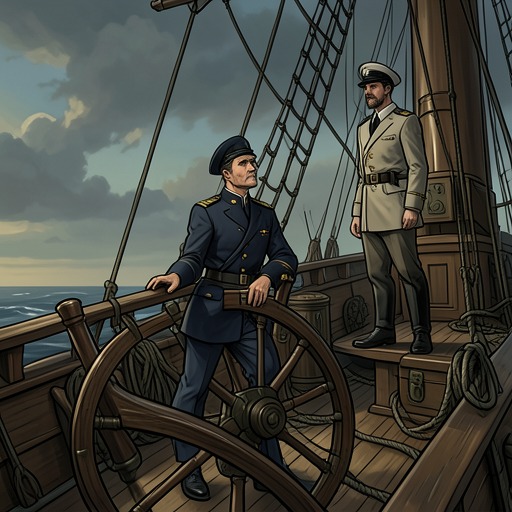
During the typhoon, Queeg has been trying to turn the Caine back toward the south as the wind shifts the ship from south to west. Steve Maryk takes the opposite course, using the ship’s movement and the engines and rudder to swing its bow north, into the wind and sea. The passage makes the disagreement physical and immediate: the issue is the ship’s heading in dangerous conditions, not an abstract difference of opinion.
Willie cannot understand Maryk’s maneuver in the moment. Sitting on deck with water around his waist and clinging to a telephone jackbox, he looks to the executive officer as if he were a wizard who might save him. His attention has narrowed to survival; Queeg, along with the ship, the Navy, and the obligations of duty, drops out of his conscious reckoning. The scene registers the crisis through Willie’s disorientation, while establishing the opposing actions of Queeg and Maryk without making Willie an informed judge of their navigational reasoning.
Keefer’s Judgment
After the Caine’s kamikaze strike, Tom Keefer offers Willie a retrospective comparison that sharply defines how he regards Queeg. Keefer says that Queeg could accept his own self-protective lies because he was stupid, whereas Keefer’s own intelligence leaves him unable to escape the knowledge that he jumped from the ship. Keefer presents this as a lasting identity: he can analyze his failure and therefore cannot forget it, unless he becomes paranoid like Queeg. The contrast is Keefer’s own, not a neutral diagnosis, and its force comes from the difference he draws between denial and painful self-knowledge.
Keefer’s comparison also complicates any easy equation of intelligence with courage. He describes himself as having brains but little guts, while Willie answers that the claim makes no sense and insists that Keefer has all the courage anyone needs. Queeg is invoked as the example of someone able to hide from an unwelcome truth; Keefer, by contrast, remains imprisoned by the fact he cannot disown. Through this exchange, Queeg’s defining feature in the available portrait is less a narrated inner life than the role he occupies in Keefer’s judgment of responsibility, fear, and self-deception.